AI Agent Frameworks Compared: LangChain vs CrewAI vs AutoGen vs LangGraph (2026)
Four frameworks. Wildly different philosophies. We've built production agents with all of them — here's what actually matters when you're choosing one.
Why AI Agent Frameworks Matter Right Now
Something shifted in the last twelve months. Gartner tracked a 1,445% surge in inquiries about multi-agent systems — not a typo. IBM, Google, and Deloitte all declared 2026 "the year of multi-agent AI." And 72% of enterprises now report they're already using AI agents in some form.
That means the question isn't whether to build agents. It's how. And the framework you pick determines your ceiling — how complex your workflows can get, how reliably they run in production, and how painful debugging will be at 2 AM when an agent goes off the rails.
We've deployed agents across all four major frameworks at Codeloop. Some projects needed quick prototypes. Others required stateful, multi-step pipelines handling thousands of requests per hour. The "best" framework changed every time. So instead of giving you a single answer, here's the full breakdown.
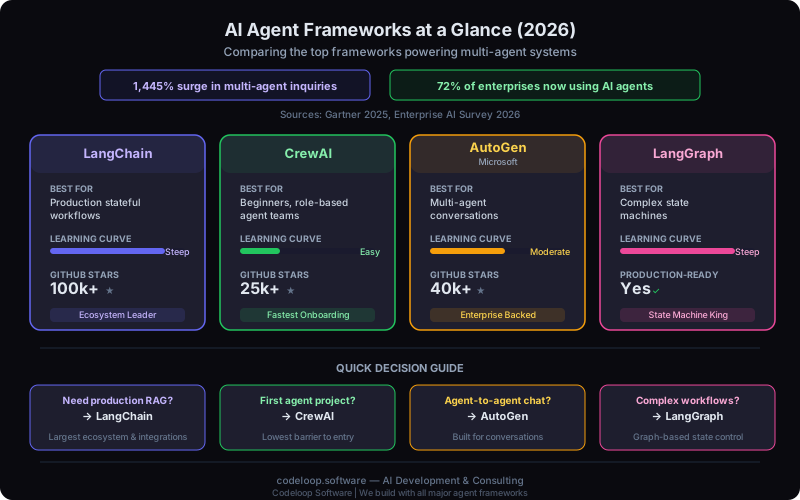
The four major AI agent frameworks compared (2026)
The 4 Major Frameworks at a Glance
Before we go deep on each one, here's the 30-second version:
| Framework | One-liner | Best for |
|---|---|---|
| LangChain | The Swiss Army knife | RAG apps, tool-calling chains |
| LangGraph | Stateful graph workflows | Complex production pipelines |
| CrewAI | Role-based agent teams | Quick multi-agent prototypes |
| AutoGen | Conversational agent groups | Multi-agent debate and research |
Now let's actually dig into what each one does well — and where it falls short.
LangChain and LangGraph: The Ecosystem Play
You can't talk about AI agent frameworks without starting here. LangChain has the largest community, the most integrations, and the longest track record. It's the default choice for a reason — and it's also the most misunderstood.
LangChain itself is a toolkit, not an agent framework. It gives you chains, prompts, memory modules, and connectors to every LLM and vector store you can think of. It's fantastic for building RAG applications, tool-calling pipelines, and single-agent workflows. But when people say "LangChain for agents," they usually mean LangGraph.
LangGraph is the production-grade agent framework built on top of LangChain. It models your agent workflow as a directed graph — nodes are actions, edges are transitions, and state persists across steps. Think of it as a state machine for AI agents. You define exactly how your agent moves between reasoning, tool calls, human-in-the-loop checkpoints, and error handling.
- Strengths — Fine-grained control over agent behavior, built-in persistence and checkpointing, excellent for complex multi-step workflows, huge ecosystem of integrations, strong typing support
- Weaknesses — Steep learning curve, verbose boilerplate for simple tasks, API churn has been painful (though it stabilized significantly in late 2025), abstraction layers can make debugging harder
- Best for — Production systems that need deterministic workflows, checkpointing, human-in-the-loop, and complex state management. If you're building something that handles real money or real data, LangGraph's explicit control is worth the extra code.
Our take
LangGraph is our default pick for client projects that need to run reliably in production. The graph-based approach feels verbose at first, but it pays off when you need to add error recovery, retries, or approval gates three months later. You never have to rewrite the architecture — you just add nodes.
CrewAI: The Fastest Path to Multi-Agent
CrewAI took a different approach entirely. Instead of graphs and state machines, it uses a metaphor everyone already understands: a team of people with job titles.
You create agents with roles ("Senior Researcher," "Technical Writer," "QA Reviewer"), give them goals and backstories, assign them tasks, and let them collaborate. The framework handles delegation, task ordering, and inter-agent communication. You can have a working multi-agent system in under 50 lines of Python.
That simplicity is real. It's not marketing — we've onboarded junior developers onto CrewAI projects in a single afternoon.
- Strengths — Lowest barrier to entry of any multi-agent framework, intuitive role-based design, built-in support for sequential and hierarchical workflows, great documentation and growing community
- Weaknesses — Less control over execution flow compared to LangGraph, limited state management for long-running workflows, can be harder to debug when agent delegation goes sideways, fewer integrations than the LangChain ecosystem
- Best for — Prototyping multi-agent workflows, content generation pipelines, research automation, and any project where you want results fast without wrestling with infrastructure
But here's the honest caveat. CrewAI's simplicity becomes a limitation when you need fine-grained control. If your workflow has complex branching logic, conditional retries, or needs to persist state across server restarts — you'll start fighting the framework instead of using it.
AutoGen: When Agents Need to Talk to Each Other
Microsoft's AutoGen takes yet another approach. Its core idea: agents are conversation participants. You create agents, put them in a group chat, and they discuss, debate, and collaborate through natural language messages.
This sounds weird until you see it work. An analyst agent proposes a finding. A critic agent pokes holes in it. A coder agent writes a script to verify the claim. A reviewer agent checks the code. The conversation continues until the group reaches consensus or a termination condition is met.
AutoGen 0.4 (the current stable release) brought a full rewrite with better typing, a new event-driven architecture, and first-class support for custom agent runtimes. It's a serious framework now, not just a research project.
- Strengths — Best-in-class for multi-agent conversation patterns, flexible group chat topologies, strong code execution support (agents can write and run code safely), built-in human proxy for human-in-the-loop, backed by Microsoft Research
- Weaknesses — Conversation-based flow can be unpredictable, agents sometimes loop or go off-topic, less intuitive for sequential task pipelines, the 0.4 rewrite means some older tutorials are outdated
- Best for — Research tasks, data analysis workflows, code generation with review cycles, any scenario where you want multiple perspectives on a problem before committing to a solution
When we reach for AutoGen
AutoGen shines when the "right answer" isn't obvious and you want agents to challenge each other. We've used it for competitive analysis projects where one agent argues for a strategy and another tries to tear it apart. The output quality is noticeably higher than single-agent approaches — but the token costs are higher too.
Head-to-Head Comparison
Here's everything side by side. This is the table we wish we'd had when we started evaluating these frameworks:
| Feature | LangGraph | CrewAI | AutoGen |
|---|---|---|---|
| Learning curve | Steep | Easy | Moderate |
| Production-readiness | High | Medium | Medium-High |
| State management | Built-in persistence | Basic | Event-driven |
| Multi-agent support | Graph-based | Role-based crews | Conversation groups |
| Human-in-the-loop | First-class | Supported | First-class |
| Community size | Largest (via LangChain) | Growing fast | Large (Microsoft) |
| Language | Python, JS/TS | Python | Python, .NET |
| Primary use case | Stateful workflows | Team-based tasks | Agent conversations |
How to Choose the Right Framework
Forget "which framework is best." Ask these questions instead:
If you're building a single agent that calls tools and follows a chain of steps, LangChain alone (without LangGraph) is probably enough. Don't add multi-agent complexity you don't need.
For prototyping, CrewAI gets you to a demo fastest. For production, LangGraph's explicit state management and checkpointing prevent the kind of failures that wake you up at night.
If you want agents to critique each other's work and reach consensus, AutoGen's conversation model is purpose-built for that. If agents just need to complete tasks in order, CrewAI or LangGraph are cleaner fits.
A team new to AI agents should start with CrewAI. A team with distributed systems experience will appreciate LangGraph's explicit control. AutoGen sits in the middle.
And here's the shortcut we give our clients: start with CrewAI to validate your idea, then migrate to LangGraph if you need production reliability. The concepts transfer. The role-based thinking you develop in CrewAI maps directly to LangGraph nodes and edges.
What About Combining Frameworks?
This is a question we get constantly. And the answer is: yes, people do this in production. But be intentional about it.
The most common pattern we see is LangGraph as the orchestration backbone with individual agents built using other frameworks. A LangGraph workflow might call out to a CrewAI crew for a content generation step, then route the output to an AutoGen group chat for review. Each framework handles what it's best at.
For larger-scale deployments where you need budget controls, org charts, and governance across dozens of agents, an orchestration layer like Paperclip sits above all of these frameworks and manages the coordination. We wrote about this pattern in our piece on building AI agent teams with Claude Code — the principles are the same regardless of which framework powers the individual agents.
That said, don't combine frameworks just because you can. Every additional framework in your stack adds debugging surface area. If one framework covers 90% of your needs, use that one and write custom code for the remaining 10%. It's almost always simpler than stitching two frameworks together.
A Quick Note on MCP
All four frameworks now support the Model Context Protocol (MCP) to varying degrees. This matters because MCP standardizes how agents connect to external tools and data sources. If your agents need to talk to databases, APIs, or file systems, MCP means you write the integration once and it works across frameworks.
LangChain has the most mature MCP support. CrewAI added it in early 2026. AutoGen's implementation is newer but functional. This is an area that's evolving fast, so check current docs before committing to a specific integration approach.
The Bottom Line
There's no single "best" AI agent framework. There's the best one for your project, your team, and your timeline.
If we had to boil it down to three rules:
- Pick CrewAI if you want multi-agent results this week and your workflow is relatively straightforward
- Pick LangGraph if you're building for production, need state persistence, and want explicit control over every step
- Pick AutoGen if your agents need to reason together, challenge each other, and converge on answers through discussion
And whatever you pick — start small. One agent, one task, one workflow. Get that working reliably. Then scale up. The teams that try to build a 10-agent system on day one are the same teams rewriting everything a month later.
The agent framework space is moving fast. What's true today might shift in six months. But the fundamentals — clear task definitions, explicit state management, proper error handling — those don't change. Pick a framework that makes those fundamentals easy, and you'll be fine.
Need Help Building AI Agents?
At Codeloop, we design and deploy AI agent systems across all four frameworks. Whether you're prototyping your first multi-agent workflow or scaling an existing system to handle production traffic, our team can help you pick the right architecture and avoid the pitfalls we've already hit.
Book a Free ConsultationFrequently Asked Questions
Which AI agent framework is best for beginners? +
CrewAI is the best starting point for beginners. Its role-based design (agents with job titles, goals, and tasks) is intuitive and requires minimal boilerplate. You can have a working multi-agent system in under 50 lines of Python. Once you understand the concepts, migrating to LangGraph for production use is straightforward.
What is the difference between LangChain, CrewAI, and AutoGen? +
LangChain (and LangGraph) uses graph-based workflows with explicit state management, ideal for production systems. CrewAI uses role-based agent teams for quick multi-agent prototyping. AutoGen uses conversational group chats where agents debate and collaborate through natural language. Each framework suits different use cases and team experience levels.
Are there significant performance differences between agent frameworks? +
Performance differences depend more on how you architect your agents than on the framework itself. LangGraph offers the most fine-grained control over execution flow, making it easier to optimize. CrewAI is fastest to prototype but can be harder to optimize at scale. AutoGen's conversational approach uses more tokens due to inter-agent dialogue but can produce higher-quality results for complex reasoning tasks.
Which AI agent framework is most production-ready? +
LangGraph is the most production-ready framework. It provides built-in persistence, checkpointing, human-in-the-loop support, and explicit state management — all critical for reliable production deployments. Its graph-based architecture makes it easy to add error recovery, retries, and approval gates without rewriting your workflow.
How do I choose the right AI agent framework for my project? +
Ask four questions: Do you need multi-agent or single-agent? Is this a prototype or production system? Do your agents need to debate or just execute tasks? What is your team's experience level? For quick prototypes, start with CrewAI. For production reliability, choose LangGraph. For agent collaboration and debate workflows, use AutoGen. You can also start with CrewAI to validate your idea, then migrate to LangGraph for production.