Paperclip vs OpenClaw: Which AI Agent Tool Do You Need in 2026?
Two open-source AI agent tools are dominating conversations in 2026, but they solve fundamentally different problems. If OpenClaw is an employee, Paperclip is the entire company. Here is how to decide which one you need — or whether you need both.
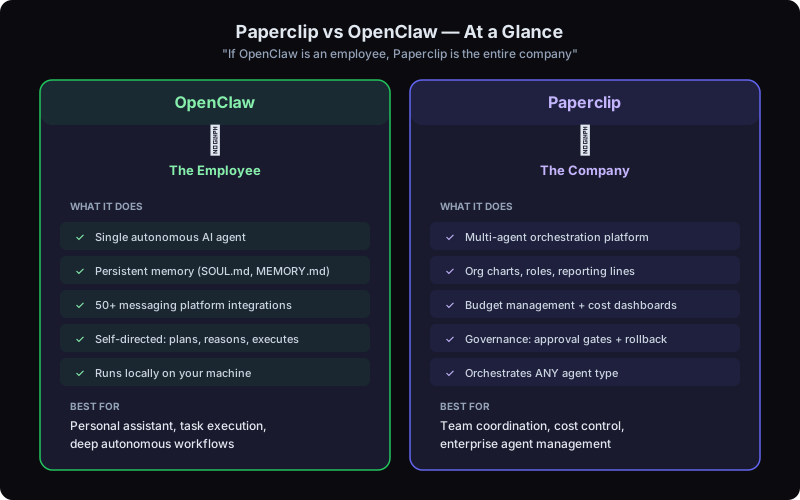
OpenClaw is the employee, Paperclip is the company — they solve different problems
The Core Difference
The agentic AI landscape in 2026 has split into two distinct categories: tools that make individual agents more capable, and tools that coordinate multiple agents into structured organizations. OpenClaw and Paperclip represent the best of each category.
OpenClaw optimizes for depth — making a single autonomous agent as capable, persistent, and self-directed as possible. It gives one agent a personality, long-term memory, and connections to dozens of messaging platforms.
Paperclip optimizes for breadth — orchestrating teams of agents with org charts, budgets, governance policies, and cross-agent communication. It does not care what kind of agent you use; it cares how they work together.
The analogy
If OpenClaw is a brilliant employee who remembers everything, plans their own work, and communicates across channels — Paperclip is the CEO, HR department, and finance team that hires, organizes, and governs a whole company of those employees.
OpenClaw: The Autonomous AI Agent
OpenClaw is an open-source autonomous AI personal assistant with over 310,000 GitHub stars, making it one of the fastest-growing open-source projects of 2026. Originally created by Peter Steinberger, it runs locally on your machine and connects to LLMs like Claude, GPT, or Gemini to execute real tasks.
What makes OpenClaw unique
- Runs locally — your data stays on your machine, no cloud dependency for the agent itself
- 50+ messaging platforms — Telegram, WhatsApp, Discord, Slack, Signal, iMessage, and more
- Persistent identity via SOUL.md — a file that defines your agent's personality, tone, and boundaries
- Long-term memory via MEMORY.md — remembers conversations, preferences, and context across sessions
- Daily notes — automatic journaling that builds a knowledge base over time
- Self-directed execution — plans, reasons, and acts without constant oversight
Getting started is straightforward. Our step-by-step OpenClaw local setup guide covers the full installation, and if you want isolation, check our Docker deployment walkthrough. Before going to production, make sure to review the OpenClaw security checklist.
Source code: github.com/openclaw/openclaw
Paperclip: The AI Agent Orchestrator
Paperclip takes a completely different approach. Instead of building a better individual agent, it provides the infrastructure to manage entire teams of agents — regardless of what those agents are. Read our deep-dive on Paperclip for the full picture.
What makes Paperclip unique
- Org charts for agents — define reporting structures, teams, and hierarchies just like a real company
- Budget governance — set spending limits per agent, per team, or per project to control costs
- Bring your own agents — works with Claude Code, OpenClaw, Python scripts, webhooks, or any other agent type
- Organization-level memory — shared context across all agents, not siloed to individuals
- Governance policies — approval workflows, audit trails, and compliance rules for agent actions
- MCP integration — uses Model Context Protocol for standardized agent communication
Source code: github.com/paperclipai/paperclip
Head-to-Head Comparison
Here is how the two platforms stack up across the features that matter most when choosing an AI agent tool in 2026.
| Feature | OpenClaw | Paperclip |
|---|---|---|
| Purpose | Individual autonomous agent | Multi-agent orchestration |
| Memory | Agent-level (SOUL.md, MEMORY.md) | Organization-level shared context |
| Scaling | Single agent, deep capability | Multiple agents, coordinated |
| Setup | npm install -g openclaw | npx paperclipai onboard |
| Best For | Personal assistant, task execution | Company-wide agent management |
| Integrations | 50+ messaging platforms | Any agent type (Claude Code, OpenClaw, scripts) |
How They Work Together
Here is the key insight most people miss: Paperclip and OpenClaw are not competitors — they are complementary. Paperclip is designed to orchestrate any agent, and OpenClaw is one of the most capable agents you can plug in. Together, they form a complete AI workforce.
Consider a real-world scenario: a company running AI agents across multiple departments. Here is what the architecture looks like when you combine both tools:
Combined Workflow Architecture
Defines the org chart, assigns budgets, sets governance policies, and routes tasks to the right agent team
Sales team (3 OpenClaw agents on Telegram), DevOps team (Claude Code agents), Support team (OpenClaw agents on Discord + Slack)
Each OpenClaw agent has its own SOUL.md personality, MEMORY.md context, daily notes, and messaging channel connections
Paperclip handles the macro level: which agents exist, what they are allowed to spend, who they report to, and what happens when something goes wrong. OpenClaw handles the micro level: how each individual agent thinks, remembers, communicates, and executes tasks. The Model Context Protocol (MCP) provides the standardized communication layer between them.
Which Should You Choose?
The right choice depends on where you are in your AI agent journey and what problem you are trying to solve. Here is a decision framework.
Choose OpenClaw if...
- You need a single powerful autonomous agent that can handle complex tasks independently
- You want a personal AI assistant with persistent memory and personality
- You need to connect an agent to messaging platforms like Telegram, Discord, Slack, or WhatsApp
- You are an individual developer or small team exploring what agentic AI can do
- Privacy matters — you want an agent that runs entirely on your local machine
Get started: How to Set Up OpenClaw on Your Local Machine
Choose Paperclip if...
- You are managing multiple agents and need to coordinate them across teams or departments
- You need budget controls and spending governance to keep AI costs predictable
- Your organization requires audit trails and compliance for AI agent actions
- You use different types of agents (Claude Code, OpenClaw, custom scripts) and need them to work together
- You are building an agent-first company and need enterprise-grade infrastructure
Get started: What Is Paperclip? The Open-Source AI Agent Orchestration Platform
Choose both if...
- You want orchestrated teams of autonomous agents — the best of both worlds
- You are scaling from one agent to many and need governance without sacrificing individual agent capability
- You are building the kind of agent-run business operations that companies are adopting in 2026
Getting Started with Each Tool
Both tools are open-source and can be installed in minutes.
Install OpenClaw
npm install -g openclaw@latestopenclaw onboard --install-daemonFollow our full OpenClaw installation guide for detailed steps, or use our Docker setup guide for containerized deployment.
Install Paperclip
npx paperclipai onboardThe onboarding wizard walks you through creating your first agent organization. Read our comprehensive Paperclip guide for a deep-dive into every feature.
The Bigger Picture: Why This Matters
The split between agent capability (OpenClaw) and agent orchestration (Paperclip) mirrors what happened in cloud computing. First we got powerful individual servers (EC2), then we got orchestration tools to manage fleets of them (Kubernetes). The same pattern is playing out in agentic AI in 2026.
Early adopters are already running multi-agent setups that handle sales outreach, customer support triage, code review, content creation, and financial reporting — all without human intervention for routine tasks. The companies that figure out the right combination of individual agent capability and orchestration governance will have a significant competitive advantage.
Whether you start with a single OpenClaw agent on Telegram or a full Paperclip organization managing dozens of agents, the important thing is to start building your AI workforce now. The tools are open-source, the community is massive, and the learning curve gets steeper every month as these platforms add new capabilities.
Need help choosing the right setup?
At Codeloop, we build custom AI agent setups using both Paperclip and OpenClaw — from single-agent personal assistants to multi-agent company-wide deployments. We handle architecture, security, governance, and integration so you can focus on results.
Frequently Asked Questions
What is the key difference between Paperclip and OpenClaw? +
OpenClaw is an individual autonomous AI agent that runs locally with persistent memory, personality, and 50+ messaging platform integrations. Paperclip is a multi-agent orchestration platform that manages teams of agents with org charts, budgets, governance, and audit trails. They are complementary, not competing tools.
Are Paperclip and OpenClaw free to use? +
Both are fully open-source and free to self-host. Your main costs will be LLM API usage (Claude, GPT, Gemini, etc.) and any infrastructure you run them on. Paperclip includes budget management features that help you control and cap those API costs per agent.
Which is better for enterprise use — Paperclip or OpenClaw? +
For enterprise deployments, you typically need both. OpenClaw provides the capable individual agents, while Paperclip provides the governance, budget controls, audit trails, and organizational structure that enterprises require. Paperclip's multi-company support also makes it ideal for agencies managing AI operations across multiple clients.
Which tool is easier to set up — Paperclip or OpenClaw? +
Both offer one-command installation. OpenClaw installs with npm install -g openclaw@latest and includes an onboarding wizard. Paperclip installs with npx paperclipai onboard and scaffolds a default company with an org chart. OpenClaw is slightly faster to get a single agent running; Paperclip requires more upfront planning to define your organizational structure.
Can I migrate from OpenClaw to Paperclip or vice versa? +
There is no migration needed because they serve different purposes. You can add Paperclip on top of existing OpenClaw agents without changing your OpenClaw setup. Simply register your running OpenClaw instances as agents within Paperclip's org chart, and Paperclip will handle orchestration, budgets, and governance while OpenClaw continues handling individual agent tasks.