Seedance 2.0: ByteDance's AI Video Model — Features, How to Use, and Full Comparison
Seedance 2.0 is the #1-ranked AI video generation model as of March 2026, scoring an Elo of 1,269 on text-to-video and 1,351 on image-to-video benchmarks. Here's everything you need to know — from features and pricing to how it stacks up against Sora 2, Kling 3.0, and Veo 3.1.
What Is Seedance 2.0?
Seedance 2.0 is ByteDance's flagship AI video generation model, built by the Seed team and launched in March 2026. It holds the #1 position on the Artificial Analysis leaderboard with an Elo score of 1,269 for text-to-video and 1,351 for image-to-video — outranking every competitor.
Unlike earlier models built on U-Net, Seedance 2.0 uses a Dual-Branch Diffusion Transformer (DiT) architecture. This enables it to process multiple input modalities simultaneously — text, images, video, and audio — making it less of a "text-to-video tool" and more of a multimodal video director.
Key Features That Set Seedance 2.0 Apart
Seedance 2.0 isn't just faster or higher-resolution than the competition. It introduces capabilities that no other model offers in a single package.
Quad-Modal Reference System
Upload up to 12 reference files in a single generation: 9 images, 3 videos, and 3 audio tracks. Use the @ reference system to tag specific assets in your prompt — for example, "@character1 walks toward @background3 while @music2 plays." No other model supports this level of multimodal input.
Native Audio-Video Co-Generation
Seedance 2.0 generates synchronized audio alongside video in a single pass — an industry first. This includes lip-sync in 8+ languages (English, Chinese, Japanese, Korean, Spanish, French, German, and Portuguese). Previous models required separate audio generation and manual syncing.
Multi-Shot Storyboarding
Describe a narrative and Seedance 2.0 automatically breaks it into scenes with consistent characters, lighting, and style across shots. This eliminates the biggest pain point of AI video — maintaining continuity across clips.
Additional standout capabilities include:
- Advanced physics simulation — gravity, momentum, collisions, fabric dynamics, and fluid behavior look physically plausible
- Video editing tools — extension, object removal, style transitions, and character replacement within existing clips
- Camera control presets — dolly, pan, zoom, orbit, and custom keyframe paths
- Approximately 30% faster generation than Seedance 1.0
Technical Specifications
Here's what Seedance 2.0 delivers under the hood.
Seedance 2.0 Specs at a Glance
- Architecture: Dual-Branch Diffusion Transformer (DiT) with MM-RoPE positional encoding
- Max Resolution: 1080p (1920×1080)
- Duration: 4–15 seconds per clip
- Aspect Ratios: 16:9, 9:16, 4:3, 3:4, 21:9, 1:1
- Input Modes: Text, image, video, audio (up to 12 files simultaneously)
- Speed: ~30% faster than Seedance 1.0
How to Use Seedance 2.0
There are three ways to access Seedance 2.0 right now, each suited to different workflows.
1. Dreamina (Primary Platform)
Dreamina is ByteDance's creative platform and the main way to use Seedance 2.0. New accounts get 800 free seconds of video generation plus 150 daily credits. The interface supports the full feature set including multi-shot storyboarding and the @ reference system.
2. CapCut Integration
As of March 26, 2026, Seedance 2.0 is available inside CapCut for Pro subscribers. Navigate to Media > AI Media > AI Video to access it. Note that CapCut's Seedance integration is not yet available in the US market.
3. API Access
Developers can access Seedance 2.0 through third-party providers including fal.ai, Atlas Cloud, and WaveSpeed AI. Important note: ByteDance paused direct overseas API access on March 15 due to Hollywood legal pressure over copyright concerns. Third-party providers still offer access.
Pricing Breakdown
- Free tier: 800 seconds + 150 daily credits on Dreamina
- Basic plan: $18/month
- Standard plan: $42/month
- Advanced plan: $84/month
- API (Fast mode): $0.022/second
- API (Pro mode): $0.247/second
Seedance 2.0 vs Competitors: Full Comparison
The AI video generation space is crowded in 2026. Here's how Seedance 2.0 compares to the top four alternatives on the metrics that matter most.
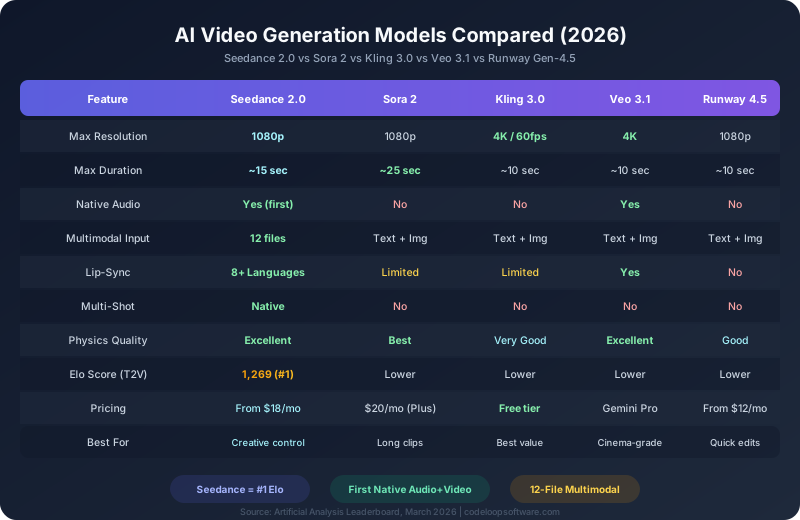
AI Video Generation Models Compared — Seedance 2.0 leads in Elo score, native audio, and multimodal input (Source: Artificial Analysis, March 2026)
Seedance 2.0 vs Sora 2
Seedance 2.0 wins on multimodal input (12 files vs Sora's text/image only) and native audio co-generation (Sora requires separate audio tools). Sora 2 wins on clip duration — it generates up to 25 seconds versus Seedance's 15-second maximum. For short-form content with complex reference material, Seedance is the better choice. For longer single-take clips, Sora still leads.
Seedance 2.0 vs Kling 3.0
Seedance 2.0 dominates on features — multi-shot storyboarding, quad-modal references, and native audio are all absent from Kling 3.0. However, Kling wins on output quality with 4K resolution at 60fps compared to Seedance's 1080p cap. Kling also offers a more generous free tier. If raw visual fidelity matters most, Kling 3.0 is worth considering.
Seedance 2.0 vs Veo 3.1
Google's Veo 3.1 is the closest competitor. Both models offer native audio generation and high-quality output. Veo 3.1 edges ahead for cinema-grade output and has deeper integration with Google's ecosystem. Seedance 2.0 wins on multimodal input flexibility and the multi-shot storyboarding feature. Your choice depends on whether you need Google Cloud integration or maximum creative control.
Seedance 2.0 vs Runway Gen-4.5
Seedance 2.0 is significantly more capable across the board. Runway Gen-4.5 lacks native audio, multi-shot storyboarding, and the depth of multimodal input that Seedance offers. Runway's advantage is its established ecosystem and integrations with professional editing software, but on pure generation capability, Seedance 2.0 is a clear step ahead.
Who Should Use Seedance 2.0?
Seedance 2.0 is best suited for users who need creative control over multi-asset video generation. The combination of AI-driven automation and fine-grained reference control makes it ideal for several key workflows.
- Content creators who need multilingual lip-sync for global audiences — 8+ language support eliminates the need for dubbing tools
- Marketing teams producing multi-shot narratives for campaigns — the storyboarding feature maintains brand consistency across scenes
- Developers building AI-powered applications that need API-driven video generation at scale
- Studios and agencies using AI for pre-visualization, storyboarding, and rapid prototyping of video concepts
Limitations to Know
Seedance 2.0 is impressive, but it has real constraints you should factor into your decision.
- 15-second maximum clip length — Sora 2 generates up to 25 seconds, which matters for dialogue-heavy or long-take content
- 1080p resolution cap — Kling 3.0 outputs 4K at 60fps, making it the better option for high-res deliverables
- No real face generation — ByteDance blocks generation of real human faces for IP and legal protection
- Overseas API paused — direct API access outside China was suspended on March 15 due to Hollywood legal pressure; third-party providers still work
- CapCut not available in the US — the CapCut integration is currently limited to non-US markets
The Bottom Line
Seedance 2.0 is the best overall AI video generation model available in 2026 for creative control and multimodal input. Its #1 ranking on the Artificial Analysis leaderboard is backed by genuine capability advantages — no other model combines native audio co-generation, 12-file multimodal references, and multi-shot storyboarding in a single tool.
If you need 4K output, Kling 3.0 is better. If you need clips longer than 15 seconds, Sora 2 wins. But for the broadest set of creative use cases — especially multilingual content, brand-consistent campaigns, and complex multi-asset generation — Seedance 2.0 is the model to start with.
Frequently Asked Questions
What is Seedance 2.0? +
Seedance 2.0 is ByteDance's AI video generation model, launched in March 2026. It uses a Dual-Branch Diffusion Transformer architecture and is ranked #1 on the Artificial Analysis leaderboard with Elo scores of 1,269 (text-to-video) and 1,351 (image-to-video). It supports text, image, video, and audio inputs for generating up to 15-second video clips at 1080p resolution with synchronized audio.
How much does Seedance 2.0 cost? +
Seedance 2.0 offers a free tier on Dreamina with 800 seconds of video generation plus 150 daily credits. Paid plans start at $18/month (Basic), $42/month (Standard), and $84/month (Advanced). API pricing is $0.022 per second in Fast mode and $0.247 per second in Pro mode through third-party providers like fal.ai.
Is Seedance 2.0 better than Sora 2? +
Seedance 2.0 outperforms Sora 2 on multimodal input (12 reference files vs text/image only) and native audio co-generation. Seedance also scores higher on the Artificial Analysis Elo leaderboard. However, Sora 2 generates longer clips (up to 25 seconds vs Seedance's 15 seconds). For short-form content with complex creative direction, Seedance 2.0 is the stronger choice.
Can I use Seedance 2.0 for free? +
Yes. New Dreamina accounts receive 800 free seconds of video generation and 150 daily credits at no cost. This is enough to test the platform and generate dozens of short clips. For heavier usage, paid plans start at $18/month.
What languages does Seedance 2.0 lip-sync support? +
Seedance 2.0 supports native lip-sync in 8+ languages including English, Chinese, Japanese, Korean, Spanish, French, German, and Portuguese. The lip-sync is generated natively alongside the video in a single pass, eliminating the need for separate audio dubbing tools.
Is Seedance 2.0 available in the US? +
Seedance 2.0 is accessible in the US through the Dreamina web platform and third-party API providers like fal.ai and WaveSpeed AI. However, the CapCut integration is not yet available in the US market, and ByteDance's direct overseas API access was paused on March 15, 2026 due to legal pressure from Hollywood studios.